
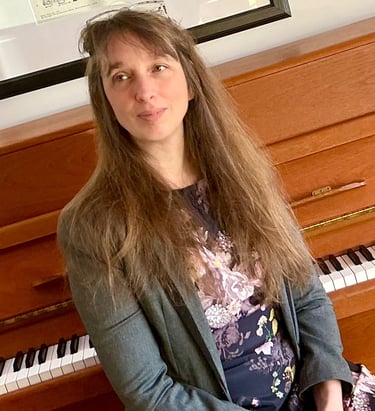
About Lois
Lois is a piano and flute teacher with around 25 years of experience. She has taught with the Derbyshire music service and at Yarlet Preparatory School, and now teaches exclusively from her home in Bedfordshire, UK. She trained at the Royal College of Music Junior Department, before gaining a 1st class honours degree and an Advanced Postgraduate Diploma in Music Performance from Birmingham Conservatoire. She studied flute with Alan Baker and Judith Hall, and piano with Jeremy Russell, and has performed extensively around the Midlands and London areas, including concertos and recitals. She also arranges and composes music, and occasionally conducts an amateur choir. Lois is a chocoholic and an animal lover.
Feedback for 4 Square Piano
"Sometimes when I look at a piece of music, I go "Oh my gosh! That's a lot of notes!" So when they are in sections it makes it so much easier. I also really like doing duets because when I play with my teacher it gives me a lot more confidence. It's amazing to hear both parts played together. I love classical music and pop music! I listen to music at home and often I realise 'Oh! I can play this!" - Lydia, pupil, age 11
"This curriculum has been a complete game changer for my studio. The kids are loving it! I use it for adults as well! It’s so well constructed and easy to understand and follow! The tie in to classical music is priceless. It has a listening list included with each level that parents and kids can listen through. Lois is a genius." - Beth Pulliam, Piano teacher
"I love using 4 square piano because it's easy to get the hang of. 4 boxes help me to learn pieces because they are structured in a way that's easy to understand." - Chloë, pupil, age 12
"4 square piano has helped Chloë build confidence as well as piano skills. The boxes break it down so that even really hard pieces don't feel overwhelming. Chloë absolutely loves her 4 square piano lessons!" - Parent
"I love the music Lois gives me because it's so happy and puts you in a good mood" - Keziah, pupil, age 10
"A beautifully presented beginner piano series with familiar melodies that engage students from the start ... an excellent all-round resource for beginners." - Janet Denham, Piano teacher
How to teach with 4 Square Piano
Each level of 4 Square Piano contains sets of pages labeled 'A', 'B' and 'C' in the top left corner. The 'A' pages are the core of the curriculum, where new concepts are introduced, together with appropriate technical exercises and repertoire. They are structured around 4 coloured boxes, intended to guide the pupil through their practice time at home. They also function as a lesson plan; by working through each box 3 times, new ideas are quickly reinforced, and with each repetition, an opportunity is created to refine technique and musicality. Good habits that are established in the lesson are more likely to be followed at home. With each level, two 'tools' for practice are introduced, so that by the time original repertoire is introduced in level 5, every student has a toolkit of excellent practice strategies.
The B and C pages are equally important, but can be used more flexibly. They can be used as in-lesson activities only for a quick learner, or they can be sent home to add variety to a practice schedule. They can be followed at a slower rate for a pupil with a spiky learning profile, or used as catch up material for students who need to recap some previously learned skills. Students often enjoy the duets most of all - they learn so much about rhythm and musicality from playing alongside a respected teacher, and really enjoy the amazing sounds that two players can make together.
I have really enjoyed seeing my own pupils flourish as they work through this material, and I hope it brings as much joy to your lessons as it has to mine. Please do reach out via email, Facebook or instagram if you have any questions!