
6 types of musician
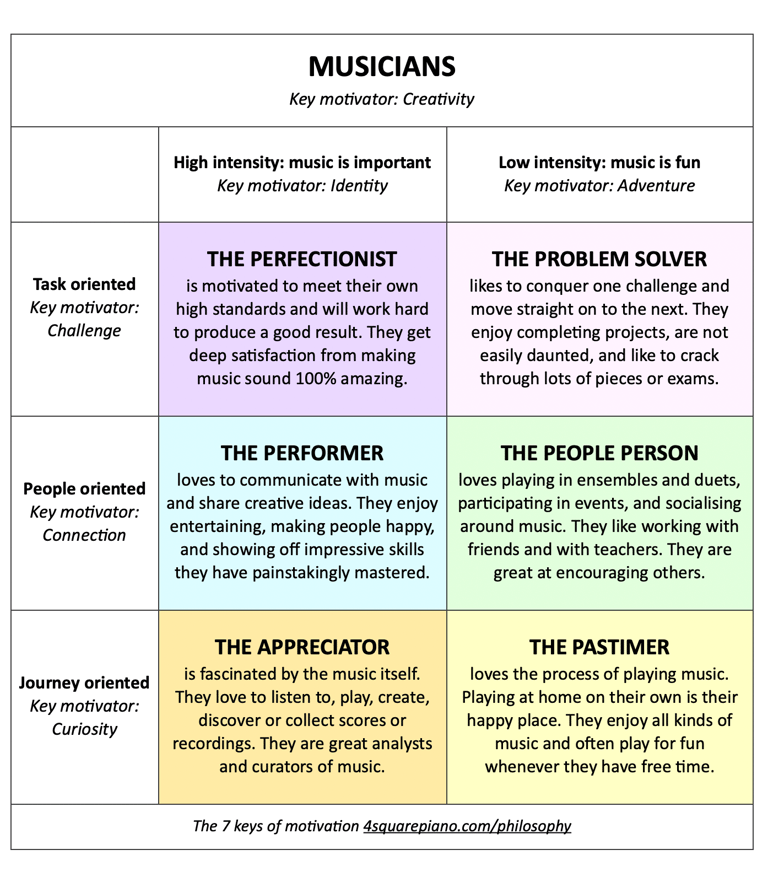
Which type of musician are you? Most of us are a mix of several colours. Do you recognise your pupils in these boxes?
Musicians are motivated by creativity, so playing music that inspires creative interpretation is always important.
For high intensity learners, we can appeal to their sense of identity - treat them as respected musicians and talk to them about how real pianists learn and improve. For the right hand column, we can lean more into a sense of adventure - learning music is a quest that involves a bit of struggle, but imagine the thrill of conquering the challenge and feeling like a ninja when you can finally play what is currently out of reach!
Task-oriented players love to see the challenge they're facing, and need to believe they can conquer it. People-oriented musicians will put in extra effort when they get to play with or for others, whether impressing the person queuing outside the door, playing duets with a respected teacher, or performing for family and friends. Fostering a sense of team spirit and choosing music that impresses others is really helpful for them. For journey-oriented students, the choice and variety of music is really important. They love to discover and try out lots of different pieces and may appreciate a listening list to help them develop their own personal taste.
The 7 keys of motivation
Behind the 4 Square Piano method is a philosophy: maximising efficient use of motivational tools in music lessons. It uses 7 'keys' to unlock intrinsic motivation in students.
The four white keys are about lesson design - what we can do in each lesson to enable motivation. The three black keys are about language - how we communicate ideas and outlooks, and paint a picture that helps pupils navigate the ups and downs of becoming a musician.
The 7 keys of motivation are inspired by the work of Yu-kai Chou (Octalysis), Edward Deci and Richard Ryan (self-determination theory), Karen Pryor (variable reinforcement and the 'jackpot' effect) and Paul Harris (Simultaneous Learning). Tech giants employ world experts like Yu-kai Chou to develop motivational strategy for apps and games. As music teachers, we need to be just as smart about our strategy if we want to help our students unlock their motivation and master the challenges that inspire them. Here's a quick overview:
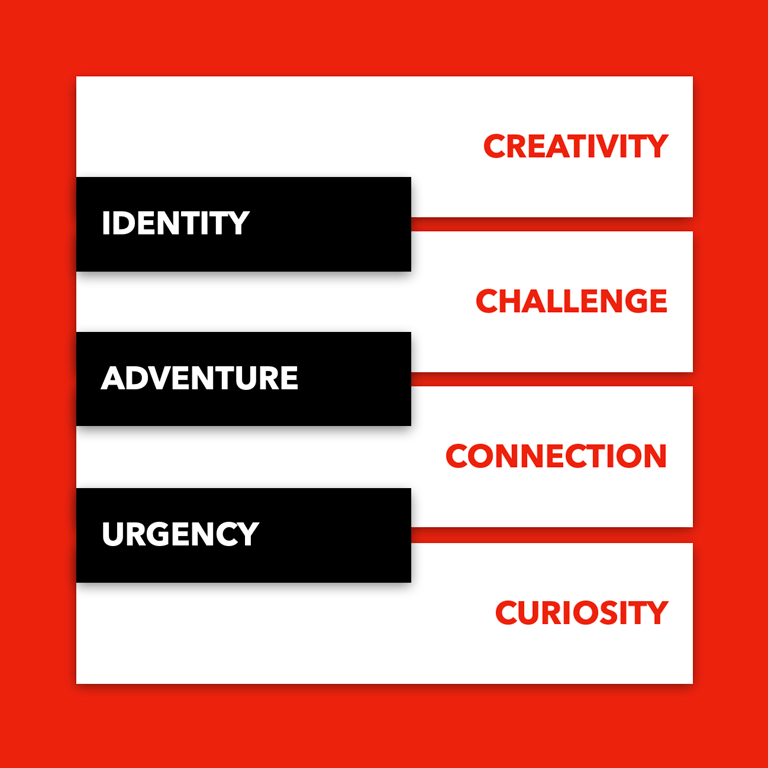
Lesson design
CREATIVITY: Creating conditions in which creativity and imagination can flourish helps intrinsic motivation to thrive too. 4 Square Piano brings in great music in every part of every lesson, so that pupils feel inspired and can think deeply about interpretation from day one. Making choices, trying different ideas, and use of a variety of practice tools are also built into the curriculum, so they can become creative music-makers and problem-solvers.
CHALLENGE: Humans thrive on a sense of achievement. Choosing the right level of challenge, coaching ahead for success and celebrating each new win together makes sure pupils really notice and enjoy all the great things they're achieving. The coloured boxes in 4 Square Piano enable a student to keep track of the bitesize challenges they are conquering in each lesson and practice session. The challenges are short enough that 3 repetitions bring about a noticeable improvement, rewarding effort. Practice is divided between technical work and repertoire, stepping up the challenge in each area systematically and incrementally. As students see their own progress, they become more confident in tackling new and bigger challenges.
CONNECTION: Music provides human connection in an increasingly impersonal world. A teacher is a coach and a sensei, a partner in music making, and the leader of a musical community. Duets are a crucial part of 4 Square Piano because they foster the relational element of music making so well; solos transform students into performers who can enjoy the social reward of making family, friends and peers say 'wow!'; and enjoyable music brings new energy to teacher as well as learner.
CURIOSITY: As teachers we can open up the world of music for our students. We want them to come to each lesson excited to find out what they will try and discover that day. 4 Square Piano introduces students to the classical hits that have endured for generations and still inspire people today: it's the perfect gateway into the endless world of musical discovery. We also need to use a mix of ingredients to keep our lessons varied and interesting, which is why 4 Square Piano is based on lots of bitesize activities, and why you can also find quick and easy games on the website, and listening lists in each level.
Language
IDENTITY: A student who says 'I am a musician' is a student who makes practice a defining part of their life. If we refer to our students as musicians, help them find their strengths, give them music that connects them to great composers of the past, and play with them regularly as two artists working together, that sense of identity will grow quickly.
ADVENTURE: Learning music is an epic quest - a journey of discovery, and a lifetime pursuit involving both goals and obstacles. A sense of adventure helps us to keep an eye on our long-term goals, and to prepare ourselves to persevere when learning is tough. We can help our pupils by keeping challenges achievable, inspiring and collaborative, and by using the language of adventure to keep them optimistic and reframe difficulty as part of their hero's journey.
URGENCY: Students who play purely for enjoyment are a pleasure to teach, and will always keep learning at their own pace. But nothing replaces a sense of urgency if a student wishes to learn quickly. Urgency can come from an impatience to improve; it can involve a sense of needing to complete a page of challenges ahead of the next lesson; or it can revolve around performances, exams or competitions. 4 Square Piano can be used for all learners, from the most relaxed to the most driven. It can be used purely for enjoyment, but is equally good for exam preparation.
If the first 4 elements are mixed together in a lesson - playing great music, successfully conquering challenges, a positive relational connection, and activities that spark curiosity, our pupils will feel motivated and want to keep coming back. If we can also foster a sense of musical identity, and our students begin to see music as an adventure, making them impatient to improve, then we are doing a huge amount to unlock intrinsic motivation.